Ḥanukka 2025: Anouchka Paches tale
Tale avholdt kvelden 2025-12-17, 28 Kislev 5786
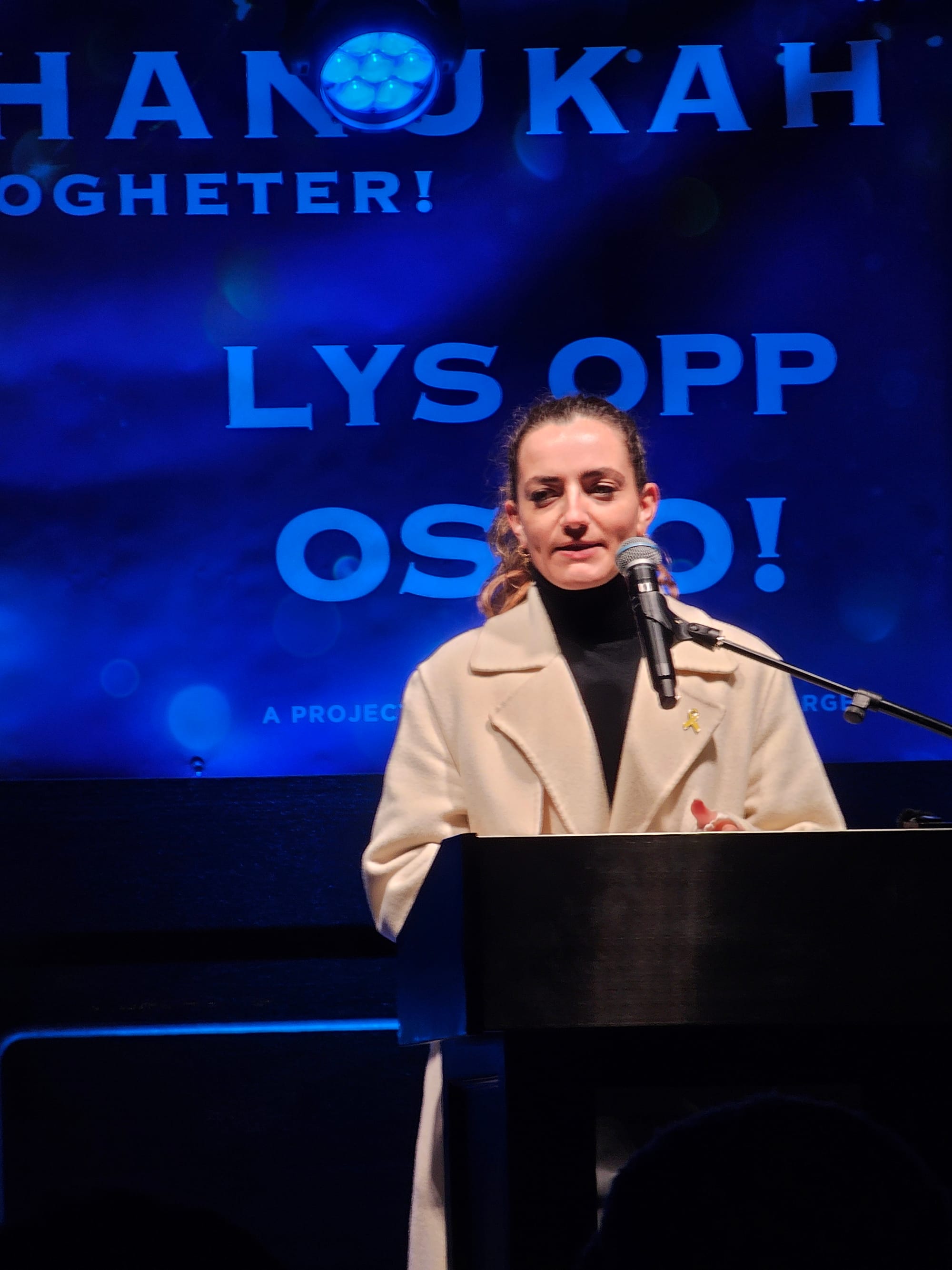
Tonight, as we gather to celebrate Hanukkah, we celebrate a story of stubborn light— light that refuses to go out, even under the most difficult circumstances.
And to be honest, it its difficult — not only physically, with the long cold winter nights, but emotionally as well.
The last two years have taken a toll on us, and the terror attack in Sydney on Sunday reminds us that the darkness is still around us.
But while I was there in my own world on Sunday — watching, scrolling, searching, checking, verifying — my 13-year-old daughter looked into my sad eyes and said to me:
“Mom, do not give in to the darkness. I need you to be the light.”
And she was right.
Because it is in darkness that we are reminded of who we are.
Nowhere was this more powerful than in the videos recently released showing our beautiful six hostages back in December 2023 lighting Hanukkah candles together in a tunnel.
A powerful symbol of defiance — a message that whatever you take from us, there is one thing you cannot touch.
It was a refusal to let themselves be reduced to bodies waiting for the tragedy that ultimately took them from us. A stubborn devotion to tradition and identity that no darkness can extinguish.
When I see the video, I recognize so clearly the moment many of you know well — when, just for a while, the world around us stops, everything else disappears, and we connect not only to Hashem, but to each other, and to the many generations before us.
It a sacred pause from a world that seems to have forgotten what is truly precious.
And yet, Omer Shem Tov, on the other hand, was completely alone.
Five hundred and five days underground.
In a place designed that was to strip away his humanity and his hope, he made the one choice he still had: he chose light.
Every morning when he woke up, he thanked Hashem — for waking up, for every tiny bit of food, and for every sip of water.
And that is extraordinary. Because they say Judaism is hardest to live in isolation.
To keep it alive alone — without a community, without witnesses, without shared time.
But Omer wasn’t just surviving physically. He was maintaining a Jewish inner life under the worst conditions.
This is more than resilience — it is a spiritual triumph.
Omer himself put it so beautifully: “It was in the darkest place that I found the most light.”
And that is the message of Hanukkah I want to share with you today.
Look at the response of the beautiful six.
Look at Omer’s journey.
Look around you — look at all of you showing up here today.
Familiar faces, new faces, happy faces, sad faces, even scared faces — but you all showed up.
And that is Hanukkah: the refusal to let darkness define us, and a stubbornness to shine even brighter whenever someone tries.
Today, Omer is free. And he says that waking up and seeing the sun is the greatest gift.
Light is no longer something he takes for granted.
And maybe none of us should.
Because light is something we have to create — each and every one of us, in ourselves, and together with others.
Because we, too, face darkness—
uncertainty,
fear,
and the heaviness of a world that overlooks, forgets, and even celebrates Jewish pain.
But it is in those moments — when we choose light, when we choose hope, when we put our trust in Hashem — that is when miracles happen.
So tonight, as we light our own candles,
in honour of the beautiful six,
in honour of Omer,
in honour of our brothers and sisters in Sydney,
and in honour of every generation of Jews who brought light into a world that did not welcome them —
Be the light.
Be loud.
Be proud.
Put every Hanukkiah you have in your window.
Don’t hide it.
Do not apologize for who you are.
Do not let darkness dim your lights.
Because we, we are the people who choose light in darkness.
Thank you — and may the lights of Hanukkah bring comfort to your homes, our communities — and remind the world that even in the darkest nights, the light of the Jewish people will never go out.